Tear Trough Filler

The skin under the eyes is some of the most delicate on the face, and it is often the first place that fatigue, genetics, and the natural aging process make themselves known. If you consistently look tired no matter how much sleep you get, or if you notice a hollow shadow running along the inner corner of your eye toward your cheek, you may be dealing with a tear trough. Filler treatment is one of the most effective non-surgical ways to address it. Deep Blue Med Spa serves patients across Long Island including Garden City, Babylon, East Hills, NYC, and Manhattan, and our team of experienced injectors has the precision and expertise this delicate area demands.1
What Is a Tear Trough?
The tear trough is a small groove that runs from the inner corner of the eye diagonally toward the cheek, creating a natural separation between the lower eyelid and the upper cheek. When this groove becomes pronounced, it casts a shadow that reads as a dark circle or hollow, giving the face a tired or older appearance even when you feel rested.
For some people, tear troughs are largely structural, shaped by genetics and bone anatomy. For others, they develop or deepen over time as the face loses volume and skin elasticity with age. Facial fat pads that once provided a smooth, seamless transition between the eye and cheek gradually diminish, and the underlying depression becomes more visible. Tear troughs can appear as early as the mid-twenties, though they tend to become more noticeable in the late thirties and beyond.2,3
Not every dark circle is a tear trough. Pigmentation from sun exposure or prominent blood vessels visible through thin skin can create a similar appearance but require different treatments, such as laser therapy. A consultation with our team will help identify what is actually causing the concern and what will address it most effectively.
How Does Tear Trough Filler Work?
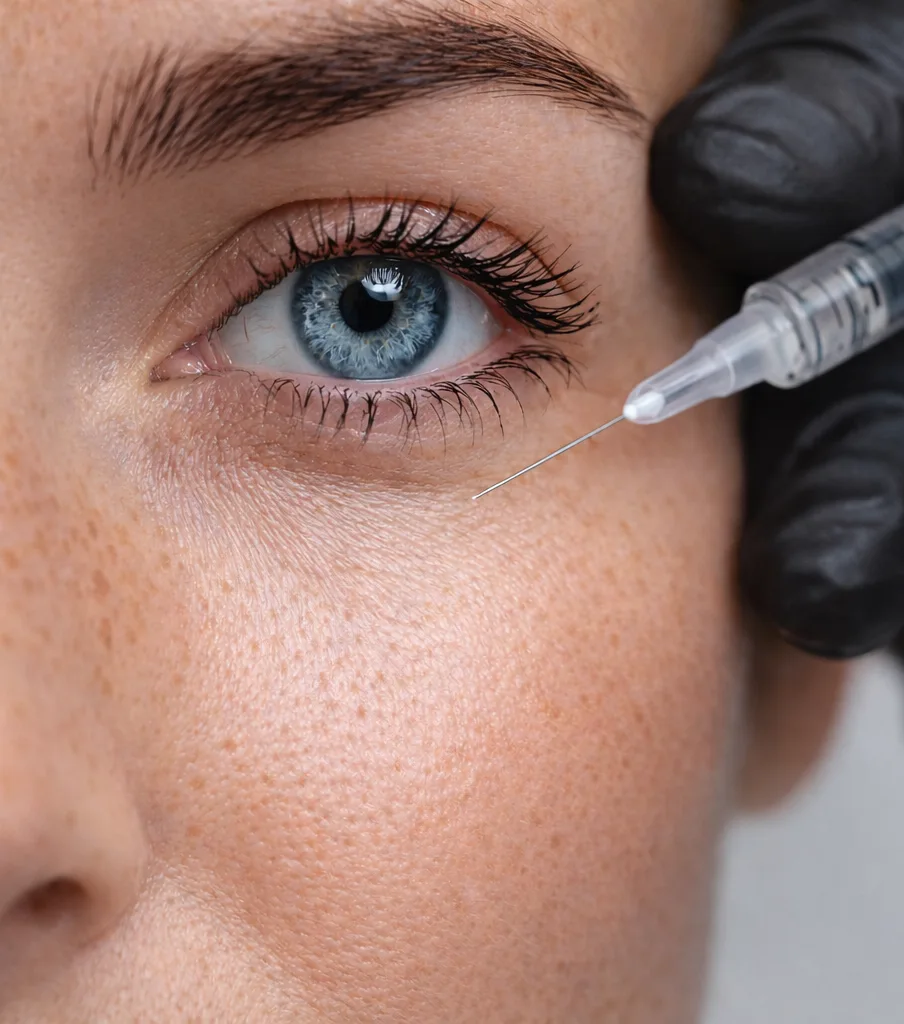
Tear trough filler is a minimally invasive injectable treatment that restores volume to the hollow beneath the eye, smoothing the transition between the lower eyelid and the cheek. When the depression is filled, the shadow it creates diminishes, and the under-eye area looks brighter and more rested.
At Deep Blue Med Spa, we use hyaluronic acid (HA) fillers for tear trough treatment. Hyaluronic acid is a substance that occurs naturally in the body and attracts moisture, giving it a smooth, gel-like consistency that integrates naturally with the surrounding tissue. It is the preferred choice for this area because of how naturally it moves with facial expressions, and because it is reversible: if adjustments are needed, the filler can be partially or fully dissolved.
Depending on your anatomy and goals, your provider may use a fine needle or a blunt-tipped cannula for the injections. The cannula technique is often preferred in this area because it reduces the risk of bruising and allows for very smooth, even placement of the filler.
Fillers Used for Tear Trough Treatment
Not all dermal fillers are appropriate for the tear trough area. The skin here is exceptionally thin, and using a filler that is too thick or too superficial can result in a bluish discoloration called the Tyndall effect. Our team selects fillers specifically suited to this area based on your anatomy and the degree of correction needed.
Restylane®
Restylane is a hyaluronic acid filler with a smooth consistency that makes it well suited for delicate areas like the tear trough. It integrates naturally with the tissue under the eye and provides subtle, even volume without appearing overdone. Results typically last six to twelve months.4
JUVÉDERM® Volbella®
JUVÉDERM Volbella is one of the thinner, more pliable formulations in the JUVÉDERM family, designed specifically for delicate areas. Its smooth gel texture and low water absorption make it a good option for patients with thinner skin under the eye, where minimizing the risk of puffiness is a priority. Results typically last up to twelve months.5
Am I a Good Candidate for Tear Trough Filler?

Tear trough filler is a good option for many adults who are bothered by the appearance of hollows or shadows under their eyes. The best candidates typically:
- Have under-eye hollowing or shadowing caused by volume loss rather than pigmentation or excess skin
- Have good overall skin health and reasonable skin elasticity
- Are in good general health with no active skin infections in the treatment area
- Are not pregnant or breastfeeding
- Have realistic expectations about what filler can and cannot achieve
Filler works best when the primary concern is volume loss creating a shadow. If dark circles are caused by pigmentation, thin skin with visible blood vessels, or significant skin laxity, alternative or complementary treatments may be more appropriate. Patients with pronounced under-eye fat pads or significant excess skin may be better served by a surgical option such as blepharoplasty. Our team will give you an honest assessment during your consultation.
Experience Tear Trough Treatment with PRO-NOX™
PRO-NOX is a nitrous oxide delivery system for fast-acting pain relief. It increases comfort and aids in calming anxiety.

Preparing for Your Treatment
A little preparation before your appointment helps minimize bruising and ensures the best possible result. In the days leading up to your treatment:
- Avoid aspirin, ibuprofen, NSAIDs, and fish oil supplements for at least 48 hours, as these can thin the blood and increase the likelihood of bruising
- Avoid alcohol for at least 24 hours before your appointment
- Arrive with a clean face, free of makeup
- Let your provider know about any medications, supplements, or recent treatments at your consultation
What to Expect During Your Tear Trough Treatment
Your appointment begins with a personalized consultation. Your provider will evaluate the structure of your under-eye area, assess your skin quality, review your medical history, and discuss the fillers best suited to your anatomy. This is also the time to ask questions and set expectations about the outcome.
On the day of treatment, the under-eye area is thoroughly cleansed and a topical numbing cream is applied to maximize your comfort. For patients who want additional relief, we also offer PRO-NOX™, a nitrous oxide system that provides fast-acting comfort during treatment.
Using a fine needle or blunt-tipped cannula, your provider will deliver precise, small amounts of filler into the tear trough to build volume gradually and evenly. Most patients describe the sensation as mild pressure. The full treatment typically takes 20 to 30 minutes, depending on the areas being addressed.
Most patients notice an improvement immediately after treatment, though some initial swelling is normal and full results become visible once any puffiness subsides, typically within one to two weeks.
Results and Recovery
One of the main advantages of tear trough filler is that there is no required downtime. Most patients return to their normal activities the same day.
Some mild swelling, redness, or bruising at the injection sites is normal and typically resolves within a few days to a week. The under-eye area is more prone to bruising than other injection sites, so some patients choose to schedule their treatment a week or two before any important events. Applying a cold compress gently to the area can help reduce initial swelling. Avoid rubbing or pressing on the treated area for 24 hours after your appointment.
Results are typically visible immediately and continue to refine over the following one to two weeks as any swelling resolves. Most patients enjoy results that last six to twelve months, depending on the filler used, the amount placed, and individual factors like metabolism and facial movement.
When results begin to fade, a follow-up treatment can be scheduled to maintain your look. Because hyaluronic acid fillers are reversible, any result that needs adjustment can be partially or fully dissolved by your provider.
Risks and Considerations
Tear trough filler is a safe, well-established treatment when performed by experienced providers, but it is also one of the more technique-sensitive injection sites on the face. Choosing a qualified, medically supervised injector is especially important here.
Potential side effects are generally mild and temporary and may include:
- Swelling or puffiness at the injection site
- Bruising
- Redness or tenderness
- Temporary irregularity in the skin surface6
A rare but important risk specific to this area is the Tyndall effect, a bluish discoloration that can occur if filler is placed too superficially or if an inappropriate product is used. This is why product selection and injection depth matter as much as technique. At Deep Blue Med Spa, our providers are experienced in this anatomy and use fillers specifically suited to the tear trough. In the unlikely event of a complication, hyaluronic acid fillers can be dissolved with hyaluronidase.
Our team will review all potential risks and contraindications with you during your consultation.

Why Deep Blue Med Spa
Deep Blue Med Spa is affiliated with New York Plastic Surgical Group, a nationally recognized plastic surgery practice established in 1948, and operates under the medical direction of Dr. Michael Dobryansky, a board-certified plastic surgeon. Every injectable treatment at our practice takes place in a physician-led, medically supervised environment, with the clinical protocols and safety standards you would expect from a surgical practice.
Tear trough filler is one of the most nuanced injectable treatments available. The anatomy is delicate, the margin for error is small, and the results depend heavily on the skill of the injector. Our team of board-certified physician assistants and nurse practitioners brings advanced training in facial anatomy and extensive hands-on filler experience to every appointment. Our lead clinicians have served as certified proctors, training other providers in injectable technique.
We serve patients across Long Island including Garden City, Babylon, East Hills, NYC, and Manhattan. Whether this is your first time considering filler or you are looking for a team with the expertise to handle a sensitive area like the tear trough, we will take the time to understand your concerns and recommend a treatment plan designed around your face.
Frequently Asked Questions
What causes tear troughs?
Tear troughs can be caused by genetics, aging, or a combination of both. As we age, the fat pads that create a smooth transition between the lower eyelid and cheek gradually diminish, making the underlying groove more visible. Some patients are simply born with a more pronounced tear trough due to their bone structure. They can appear as early as the mid-twenties and tend to become more noticeable from the late thirties onward.7
Is tear trough filler painful?
Most patients find the treatment very tolerable. A topical numbing cream is applied before the procedure to minimize discomfort, and many providers use a blunt-tipped cannula in this area, which is generally more comfortable than a needle. We also offer PRO-NOX, a nitrous oxide comfort system, for patients who want additional relief during treatment.
How long does tear trough filler last?
Results typically last six to twelve months, depending on the filler used, the amount placed, and individual factors like metabolism. Restylane and JUVÉDERM Volbella both provide results in this range. Consistent maintenance treatments can help sustain your results over time.
Is tear trough filler reversible?
Yes. Hyaluronic acid fillers like Restylane and JUVÉDERM Volbella can be partially or fully dissolved using an enzyme called hyaluronidase if any adjustments are needed. This is one of the reasons HA fillers are the preferred choice for this area.
What is the Tyndall effect and how is it avoided?
The Tyndall effect is a bluish discoloration that can occur when filler is placed too close to the surface of the skin, particularly in areas where the skin is very thin, like under the eyes. It is avoided by selecting the right filler product for the area, placing it at the correct depth, and using proper technique. This is one of the reasons that injector experience matters so much for this treatment.
Can tear trough filler help with dark circles?
It depends on the cause. If dark circles are created by the shadowing effect of a hollow tear trough, filler can make a significant difference by restoring the volume that casts the shadow. If the darkness is caused by pigmentation or visible blood vessels beneath thin skin, filler alone will not resolve it and alternative treatments like laser therapy may be more appropriate. Our team will assess the underlying cause during your consultation.
What is the difference between tear trough filler and blepharoplasty?
Tear trough filler is a non-surgical injectable treatment that addresses volume loss and hollowing beneath the eye. Blepharoplasty is a surgical procedure that removes or repositions excess skin and fat around the eyelids. Filler is ideal for patients whose primary concern is hollowing or shadowing from volume loss. Patients with significant skin laxity, excess fat, or more advanced changes may achieve better results with surgery. Our providers will help you determine which approach is appropriate for your anatomy.

Contact Us
Ready to look as rested as you feel? Schedule your consultation at Deep Blue Med Spa, serving patients across Long Island including Garden City, Babylon, East Hills, NYC, and Manhattan. Our team is here to help you achieve a naturally refreshed result with the expertise and care you deserve.
1 Urdiales-Gálvez F, Farollch-Prats L. Management of Tear Trough with Hyaluronic Acid Fillers: A Clinical-Practice Dual Approach. Clin Cosmet Investig Dermatol. 2021 May 11;14:467-483. doi: 10.2147/CCID.S301117. PMID: 34012281; PMCID: PMC8127324. Available: https://pmc.ncbi.nlm.nih.gov/articles/PMC8127324/. Accessed May 21, 2026.
2 Urdiales-Gálvez F, Farollch-Prats L. Management of Tear Trough with Hyaluronic Acid Fillers: A Clinical-Practice Dual Approach. Clin Cosmet Investig Dermatol. 2021 May 11;14:467-483. doi: 10.2147/CCID.S301117. PMID: 34012281; PMCID: PMC8127324. Available: https://pmc.ncbi.nlm.nih.gov/articles/PMC8127324/. Accessed May 21, 2026.
3 American Society of Plastic Surgeons. What are the risks of dermal fillers? https://www.plasticsurgery.org/cosmetic-procedures/dermal-fillers/safety. Accessed May 21, 2026.
4 Galderma Aesthetics. Restylane Prescribing Information. https://www.restylaneusa.com/hcp. Accessed May 21, 2026.
5 Allergan Aesthetics. JUVÉDERM Volbella XC Prescribing Information. https://www.juvederm.com/hcp. Accessed May 21, 2026.
6 American Society of Plastic Surgeons. What are the risks of dermal fillers? https://www.plasticsurgery.org/cosmetic-procedures/dermal-fillers/safety. Accessed May 21, 2026.
7 Urdiales-Gálvez F, Farollch-Prats L. Management of Tear Trough with Hyaluronic Acid Fillers: A Clinical-Practice Dual Approach. Clin Cosmet Investig Dermatol. 2021 May 11;14:467-483. doi: 10.2147/CCID.S301117. PMID: 34012281; PMCID: PMC8127324. Available: https://pmc.ncbi.nlm.nih.gov/articles/PMC8127324/. Accessed May 21, 2026.